Your Trusted Partner from Prototyping to Mass Production, Email Us:info@highlymachine.com
Please Choose Your Language


Views: 222 Author: Ann Publish Time: 2025-12-25 Origin: Site


Content Menu
● Understanding the Role of SMT Feeders
>> Key Features of Tape Feeders
>>> 1. High Speed and Productivity
>>> 4. Reduced Human Intervention
>> When Tape Feeders Are the Best Choice
>> Key Features of Tray Feeders
>>> 1. Gentle Component Handling
>>> 3. Ideal for Low-to-Medium Volume Production
>>> 4. Precise Recognition and Loading
● Key Factors to Consider When Choosing SMT Feeders
>> 1. Component Packaging Type
>> 2. Production Volume and Speed
>> 4. Budget and Cost of Ownership
>> 5. Line Configuration and Space Constraints
>> 7. Feeder Intelligence Features
● Common Challenges in SMT Feeder Operations
>> How to Prevent These Problems
● Advanced Feeder Integration: The Hybrid Approach
● Feeder Maintenance and Calibration Tips
● FAQ (Frequently Asked Questions)
>> 1. What does an SMT feeder do?
>> 2. Can one SMT line use both tape and tray feeders?
>> 3. How can I maintain my SMT feeders to reduce production issues?
>> 4. Are SMT feeders brand-specific?
>> 5. Why choose Highlywin for SMT feeders and solutions?
In modern Surface Mount Technology (SMT) assembly, feeder selection is one of the most crucial yet often overlooked factors affecting manufacturing efficiency. The choice between tape feeders and tray feeders can determine how smoothly your production line operates, how consistently components are placed, and how effectively downtime is minimized.
As a professional SMT equipment and support provider, Highlywin delivers one-stop SMT solutions worldwide, including sales of SMT/AI equipment, SMT feeders, spare parts, and full technical support. This guide explains the key differences between tape and tray SMT feeders, compares their advantages, and helps you choose the best option for your electronic assembly line.

Every SMT production line requires a precise and reliable component feeding system. SMT feeders serve as the bridge between component packaging and pick-and-place machines. Their primary role is to deliver each part to the exact pickup location with perfect alignment and timing.
There are three major types of SMT feeders commonly used:
- Tape feeders: Handle components stored in tape-and-reel packaging.
- Tray feeders: Handle components placed in trays, such as QFPs, BGAs, or connectors.
- Stick feeders: Designed for components packed in elongated tubes.
Each type has its own applications. The choice depends on component shape, size, fragility, and the production environment.
Tape feeders supply components directly from a carrier tape wound onto a reel. The tape has cavities that hold individual components, protected by a cover tape. As the reel turns, the SMT feeder peels back the cover film and advances the tape to expose each component for pickup by the placement head.
- Compact design for high feeder density.
- Automated tape advance and cover peeling mechanism.
- High-speed synchronization with placement machine timing.
- Available in multiple widths (8mm, 12mm, 16mm, up to 72mm).
Tape feeders are ideal for continuous, high-volume production. Their smooth automation ensures components are always available for pickup, maximizing machine uptime.
Most electronic components (resistors, capacitors, ICs) come in tape-and-reel packaging conforming to EIA-481 standards, allowing easy integration with nearly all SMT feeders.
Because tape feeders can be mounted side by side, they allow high component variety even in limited space.
With automatic indexing and sensing, tape feeders minimize operator effort and reduce the chance of misfeeds or placement errors.
Tape feeders are the default solution for high-speed SMT lines. If your production involves standard surface-mount components, frequent product runs, and the need for rapid changeovers, tape feeders deliver unmatched efficiency.
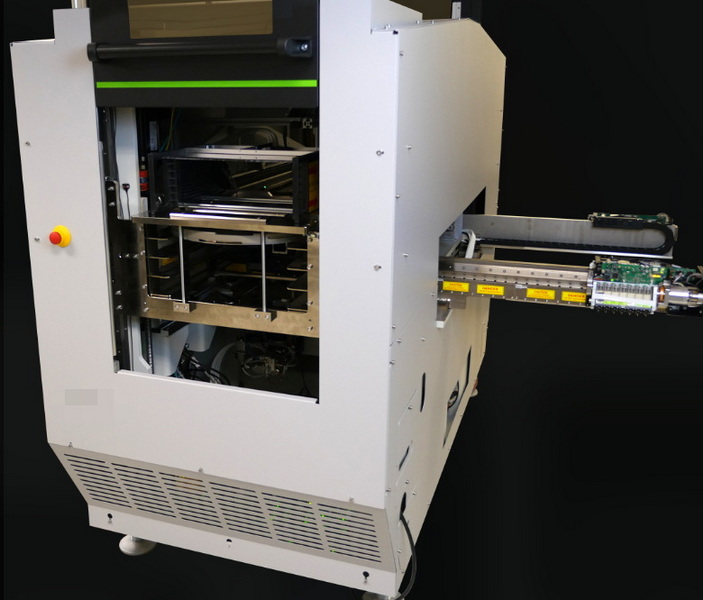
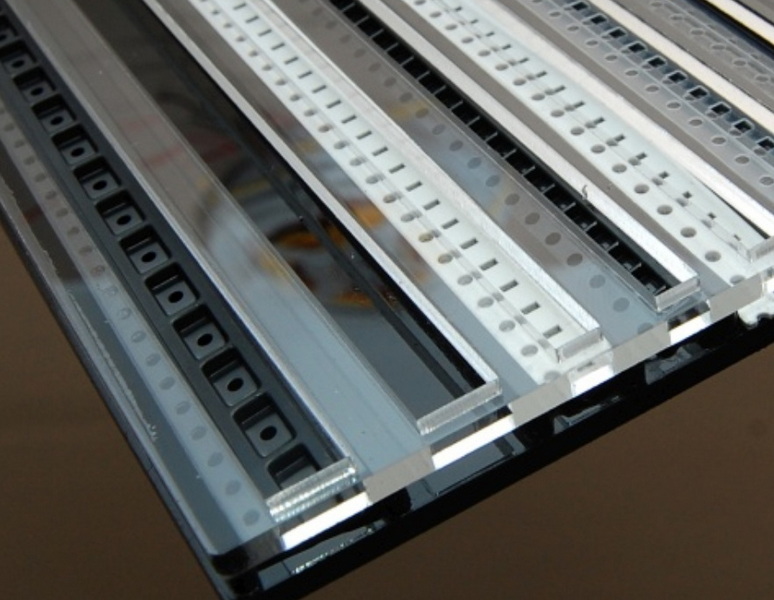
Unlike tape feeders, tray feeders store components in matrix trays — grid-like plastic carriers where each cavity holds one part. These feeders are typically used for large, expensive, or delicate components that cannot withstand the bending or friction of tape packaging.
- Designed for larger, complex components.
- Usually built with automatic tray handling or exchange systems.
- Programmable feeding sequence to match pick-and-place machine cycles.
- Can handle various tray formats, including JEDEC-standard trays.
Tray feeders are perfect for sensitive packages such as QFNs, BGAs, CSPs, and connectors that require careful handling to prevent scratches, warping, or electrostatic discharge.
Tray feeders can adapt to components of different shapes or sizes without the need for customized tape designs.
For OEMs or prototype manufacturers who frequently change product types, tray feeding provides flexibility and fast setup.
Vision-guided systems integrated with tray feeders ensure accurate component positioning, improving overall placement yield.
Use tray feeders when dealing with components that are too large, heavy, or complex for tape packaging. They are invaluable in prototype assembly, engineering validation runs, or low-volume, high-mix production environments.
Selecting the right SMT feeder system for your production environment requires a clear understanding of the following parameters:
Most passive components and small semiconductors come in tape format, while advanced ICs are shipped in trays. Matching your feeder type to your component packaging is essential.
High-volume runs benefit from continuous tape feeding to avoid downtime. For small-batch production or custom assemblies, tray feeders offer convenience.
Ensure your SMT pick-and-place system supports the mechanical and software interfaces of your chosen feeder brand.
Tape feeders are generally less expensive and easier to maintain, but tray feeders can save costs by preventing damage to costly components.
Tape feeders are compact and modular. Tray feeders, in contrast, require more physical space but enable flexible handling for special devices.
If your production requires frequent part or job changeovers, tape feeders equipped with quick-load carts or intelligent feeder systems are highly advantageous.
Many modern feeders come with smart functions like barcode recognition, component tracking, and auto-calibration. These enhance traceability and reduce human error.
While SMT feeders are designed for precision, improper use or lack of maintenance can introduce issues. Typical problems include:
- Tape misalignment or jamming, causing skipped placements.
- Improper cover tape peeling tension, leading to double pickups.
- Worn feeder gears or sprockets, affecting advancement accuracy.
- Incorrect tray mapping, resulting in component position errors.
- Electrostatic discharge risks in tray-fed sensitive ICs.
- Regularly clean feeder mechanisms and replace worn-down parts.
- Validate feeder calibration using vision alignment tools.
- Store feeder units in clean, dry, and ESD-safe conditions.
- Update machine software for feeder offsets and pick coordinates.
- Train operators to handle feeders carefully during setup and teardown.
Modern SMT production increasingly embraces a hybrid feeder configuration, combining tape and tray feeders in one integrated line. This setup allows manufacturers to:
- Use tape feeders for standard passive components.
- Employ tray feeders for BGA, LGA, or connector packaging.
- Maintain production flow without reprogramming the machine layout.
- Achieve both high throughput and product flexibility.
Using Highlywin's feeder integration technology, customers can easily mix feeder types while maintaining synchronization and machine balance, resulting in a highly adaptable SMT environment.
Regular maintenance ensures the precision, reliability, and service life of your SMT feeders. Here are several proven practices:
1. Daily Cleaning: Remove dust, residue, or tape particles from the feeder path.
2. Weekly Inspection: Check gears, sprockets, and pressure arms for wear and replace if needed.
3. Calibration: Use calibration jigs and software tools to confirm pickup accuracy.
4. Lubrication: Apply suitable lubricants to mechanical parts according to manufacturer guidelines.
5. Record Keeping: Maintain maintenance logs for traceability and production audits.
6. Feeder Testing: Prior to production, simulate pickup to verify component presentation timing.
These practices substantially reduce feeder-related downtime and component loss, ensuring the overall stability of your SMT assembly line.
With decades of experience in the electronics manufacturing industry, Highlywin is dedicated to providing customers worldwide with integrated SMT solutions. Our services include:
- Sales and distribution of new and refurbished SMT feeders compatible with brands like Panasonic, Yamaha, Fuji, Juki, Siemens, and Universal.
- Feeder calibration, repair, and technical support.
- Complete SMT line design, including pick-and-place machines, AOI, and reflow systems.
- Spare parts supply and automation upgrades.
We not only supply the hardware but also guide customers in selecting, installing, and optimizing their SMT feeders for maximum efficiency and ROI.
Choosing between tape feeders and tray feeders is not merely a hardware decision — it reflects your overall manufacturing priorities. Tape feeders dominate in high-speed, high-volume assembly, while tray feeders are unmatched when handling fragile, expensive, or nonstandard components.
Adopting a hybrid strategy that leverages the strengths of both can deliver the perfect balance of flexibility, accuracy, and cost efficiency. Proper feeder selection enhances throughput, reduces error rates, and extends the lifespan of your SMT systems.
At Highlywin, we understand the complexities of SMT processes and provide tailored SMT feeder solutions for every application. Whether you're optimizing a high-speed line or building a flexible assembly cell, our expertise ensures your success in electronic manufacturing.
An SMT feeder supplies components to the pick-and-place machine during PCB assembly. It ensures accurate positioning for each component and sustains continuous operation without manual feeding.
Yes. Most modern SMT systems allow a combination of tape and tray feeders. This enables manufacturers to handle both small passive components and large ICs simultaneously.
Routine maintenance such as cleaning, calibration, and replacement of worn parts is key. Always check feeding accuracy and tape tension before large production runs.
Many feeders are brand-specific due to mechanical and software interface differences. However, Highlywin provides cross-compatible and OEM-quality feeders suitable for various SMT brands.
Highlywin offers global one-stop SMT support — from equipment sales and feeder supply to process optimization and after-sales service. Our products ensure stability, compatibility, and excellent performance for all SMT operations.


